amateur-radio

VK4MSL/BM: First true bicycle-mobile contact: ZL3SV

Well… it seems my tinkering has paid off. This weekend was the weekend of the International Lighthouse Lightship Weekend… and also a federal election.

On Tuesday, I bought a trailer for the bicycle … this is primarily so that I can transport groceries, etc… to home since I’ve got the place to myself for a few weeks and need to be independent. Being so low to the ground, the trailer is hard to see, so I made the decision to move the CB whip over to the trailer, not only does it now radiate a signal, but it also alerts drivers to the trailer’s presence.

I was up to 3AM figuring out how to mount this antenna on the trailer… but eventually I cobbled together a mounting, moved the homebrew autotransformer over, and hey presto… I had nailed the propagation and visibility problems all at once. SWR is still horrid with the CB whip on the trailer, but the autotransformer brings it down to a manageable <15:1 SWR, which the AT-897 can deal with easily.

On the way to the event, I had the station on 14.200MHz… I heard a Chinese station… a BT call, and also later, a New Zealand station. Didn’t make any contacts until I got to the Bulwer Island lighthouse (AU0003) where I made contact with VK5SR, Cape Jaffer Lighthouse (AU0007), registering a weak 53 signal.

On the way home this evening, I first started hunting for a 40m tap on the autotransformer… found one that gave me a 10:1 SWR on 7.080MHz… Okay, not great, but better than the >25 I’d get otherwise.

Around Bardon, I was hearing some VK7 stations, tried to make contact, but I was in amongst their noise floor. As I got to Ashgrove, I tuned around and heard VK3ARK, Cape Liptrap Lighthouse (AU0037). Managed to make contact, and initially registered a 56 signal, but quickly dropped off as I rolled down the hill towards St. John’s Wood… by the time I hit Royal Parade I had dropped off completely. They got that I was mobile, not sure about the bicycle bit… but never mind. 🙂

I travel to the end of the road, trying to put out a few calls, then when I join the bike path I pause, and have a tune around… a very loud signal on 7.145MHz just about blew me away. I listened for a bit as I cycled… it was Gary ZL3SV, in the South Island of New Zealand.

He was in contact with a US station in New Jersey at the time. I could just make out the US station, however Gary just about blew me off the bike… so I waited for a break and called in. 2 others also jumped in… VK4FMVC and VK3BOT. I was barely able to hear VK3BOT, couldn’t hear VK4FMVC (40m can be like that). Gary could hear me though… he was getting me a strong 58 signal. When I checked the S meter briefly, he was registering 59+. This was around 7:00PM (UTC+10).

I was doing 100W at the time… running off a 9Ah SLA battery. I suspect I’d be lucky if even half of that was being radiated by the CB whip… Gary mentioned he was using 200W into a 1500′ centre-fed sloper… undoubtedly an excellent system. I’ll have to see about sending a QSL card over to NZ. As I continued home, there was also a VK6 station that joined us on the frequency, however I didn’t get to make a contact there… and I was nearly home.

I don’t think I’ll make HF a regular habit on the bike, but I’ll consider doing it again sometime. I’ll also see if I can document the setup a bit more… as it’s showing a good deal of promise. This was one contact I really didn’t think I’d be able to make.

VK4MSL/BM HF: Second stationary test contact

Well… after borrowing an antenna analyser and tweaking a few things… I made my second stationary contact using the bicycle mobile station on 20m.  This time, using 20W transmit power.  I now know where to place at least one of the taps on this autotransformer for 20m use. 😉  The station borrows heavily on the “Wonder Whip” style concept, where an autotransformer provides a means of matching the wild variances in impedance of the antenna, to something reasonable for the radio to cope with.

Shown here, is the station, exactly as it was during this contact.  The fibreglass 6′ CB whip has been spray painted yellow to make it more obvious, I plan to put a flag on there so that it resembles a bicycle safety flag (a big one) so it arouses less suspicion.  Click on any of the photos for a closer view.

VK4MSL/BM HF: as set up during the contact

VK4MSL/BM HF: as set up during the contact

This weekend was the day of the Remembrance Day contest, which is one of the major contests ran by the WIA.  Tuning around on 20m, I heard Kirby VK7KC booming in a S8 from the apple isle.  At first I tried contact with 5W, no dice… then 10W, then 20W… no luck.

I tuned off, and tried a different tap on the autotransformer… bingo, that sounded a bit noisier… I hit the button on the autotuner to clean up any last issues with the SWR, then tuned back and had another go.  Eventually after some perseverance, contact was made.

Below is a shot of the FT897D showing the frequency and S-meter reading shortly after the contact was made…. I was weak into Tassie, but that didn’t matter to me… as far as I was concerned, if I got outside metropolitan Brisbane, I was happy.

FT-897D frequency and S-meter during contact with VK7KC

FT-897D frequency and S-meter during contact with VK7KC

I haven’t yet tried other bands, although I’ve figured out some tap points for 6m, 10m and 15m… and some possible maybe points for 40m although I think the antenna will be very deaf down there.

On 80m it’ll probably be a mostly receive-only antenna, with maybe a Tx range of under 10km… if it’s enough for me to know what’s going on with the AWNOI net before I get home … and to maybe get a message relayed to VK4SD so I don’t get hassled about a late note, it’ll be great. 😉

The transformer still uses a map pin pushed though to select the tap… I’m not sure how well this will go long-term, and I think moving towards using banana plugs (or at the very least, alligator clips) will be a better solution.  Switches are another possibility.  Something that will be a more reliable connection than a pin pushed through a wire.  Shown here, is a close-up of the rear basket, the autotransformer is shown underneath the antenna bracket… which helps provide a bit of capacitance.  I find having it close up against the bracket helps, although I made provisions to be able to hang it vertically too (thereby reducing the coupling).

Rear basket showing homebrew autotransformer

Rear basket showing homebrew autotransformer

For now I’ll probably solder the centre conductor of the coax in place of the map pin, so that it’ll stay put until I can find a more convenient solution.  At least I have something on HF that works to a moderate degree.  I’ll probably give it a try next weekend on my way to the Queensland Maritime Museum, where I’ll be operating the Bulwer Island lighthouse as VK4MM in the International Lighthouse Lightship Weekend.  Hopefully I can stir up 20m sufficiently so that there’ll be some activity when 00:00 UTC rolls around.

VK4MSL/BM HF: The autotransformer

Well, I did some experiments this weekend regarding the bicycle mobile station using an autotransformer to match the shortened end-fed whip (6′ 27MHz helically-wound) to the 50ohm impedance my set demands.

I haven’t tried this on the bike itself… these were done in my bedro^W(ahhem) “radio shack”… with the antenna and its bracket sitting on a wooden chair connected to a longer bit of coax than I’ll probably use on the bike.  I will have to try this on the bicycle (ideally with an antenna analyser) to get a better idea of performance, and the up-coming Remembrance Day contest may provide a good opportunity to gauge performance, as the bands will be sufficiently “busy”.

The autotransformer is a simple design… about 50 turns of cheap speaker wire (~1.5mm diameter; ~0.2mm insulation thickness) on a 42mm OD PVC pipe section about 160mm long.  The pipe has small holes down its length, drilled at a spacing approximately identical to the wire centre-to-centre spacing (2mm).  The two extremes of the coil connect to the antenna and the metal antenna bracket respectively, the latter also connecting to the braid on the coax going back to the radio (about 30cm RG58C/U coax).  The centre conductor of the coax connects to a short piece of wire which is soldered to a small map pin, which is simply pushed through the wire’s insulation, piercing it and poking through the hole in the PVC pipe… I can select any turns ratio from 1:1 to 1:50, achieving a very wide matching ratio.  (On paper, able to match >10kOhm impedances to 50ohm.)

Early testing seems to indicate the ability to obtain good SWR figures on 6m, 10m, 20m and 40m.  80m (the holy grail for me) eludes me… and I suspect the actual radiated signal will be very low down to most stations… but if I can cover parts of metropolitan Brisbane with it, I guess I’m doing okay.  The fact that this antenna got down to VK5 with 100W up it, is a promising sign… perhaps with the autotransformer, it may do better.  Then again, it may do a lot worse… We’ll see.  Plan is to try and get it up and running before the ILLW… so that I can stir up some activity on the bands on my way to the Bulwer Island lighthouse (AU0003) before becoming VK4MM and operating a station there.

VK4MSL/BM: Photos of the current setup

Well, I’ve been riding a lot between West End and The Gap, and I get a lot of questions from people on the band about my setup. I was doing some repairs… one of the wires to the PTT had disconnected, luckily there was a 0V return via other connections… and so while I had the bike outside fixing that (it was too dark in the garage) I took the opportunity to snap some photos.

The light was fading at the time, so the pictures aren’t particularly great… I’ve touched them up to make them brighter, hence there’s a bit of noise in the photo… The last two showing the HF setup, required a flash (which I was trying to avoid due to the aluminum and reflectors)… and of course I didn’t spend time putting the FT-897D in the back… maybe later when I get everything tuned up and actually do make a true bicycle-mobile contact on HF (this one was not made mobile).

VK4MSL/BM on 2m

VK4MSL/BM on 2m: side view

Above, is the station in its entirety… fairly simple. The antenna is a plain 2m ground-plane, formed using a tunable mobile whip cut for 145.700MHz, the aluminum angle bracket makes up one counterpoise, and an additional counterpoise hangs out the back. Adjusting the angle has an influence on the SWR… in this arrangement, it works nicely.

VK4MSL/BM: Closeup of rear basket

VK4MSL/BM: Closeup of rear basket

Shown here is the rear basket where the FT-290R II (or FT-897D for HF) lurks… along with a 9Ah gel cell battery, which also powers the tail light. I haven’t been very neat about the cables. Two leads run from the front controls, the grey one (shielded) carries transmit/receive audio and the PTT, the blue one (Cat5e UTP) carries the four directional buttons — with spare wires connected to 0V. A DB15HD (“VGA”) connector terminates the cable at each end.

VK4MSL/BM: Radio controls

VK4MSL/BM: Radio controls

Remember how I mentioned the hand-mic in the last station was going to be temporary? Well… this is the arrangement here. Shown here is the PTT switch (red) and four directional buttons. Not all radios make use of all buttons … the FT-290R II uses only the up/down buttons, the FT-897D uses the right-hand button in addition for the “fast” button. Homebrew microcontroller-based radios I build will probably use all five shown for a menu interface. There’s no display in front of me, so don’t ask for an accurate signal report, I can tell you whether it’s a Q3 or a Q5, but any S-meter reading will be a wild guess. Future expansion of this may include a small potentiometer for a local volume control, and a small microcontroller-driven LCD that could be used to interface to the FT-897D’s CAT interface… but this is just early days.

Now… I did say I managed to mount a HF antenna on here and make a contact with it. The contact into VK5 that yielded this QSL card was made using a 6′ long CB whip… the station looked a lot like this:

VK4MSL/BM: HF Antenna

VK4MSL/BM: HF Antenna

The flash was needed here, took me a while to figure out where I had put the bracket (I don’t plan to ride with the HF antenna or bracket mounted very often). This is fortuitous in a way since you can now more visibly see the 2m antenna. The CB antenna mounts on a nearly identical bracket. I don’t bother with the radial out the back, as there’s no way I’ll make one long enough that would be practical. The antenna will need some work, in particular, either addition of a base-load coil, or modification, to make it resonant on the amateur bands.

VK4MSL/BM: Closeup of basket with HF mount

VK4MSL/BM: Closeup of basket with HF mount

With a small base-load coil, I should be able to make it a half-wave end-fed on 6m… some more and I should be able to make an end-fed quarter-wave on 10m. This will be the subject of future experiments. This tuning section will probably mount on top of the mounting itself, underneath the spring shown on the right.

And to answer the number one question I get from non-radio amateurs… no… I do not have a camera on my helmet (this is not a camera)… I am not broadcasting video. Kindly don’ t act like someone excited to be on television… you’re not. 😉

Open firmware

I was just reading back through the posts on Gentoo Universe… and Diego’s post regarding Free Software Washing Machines caught my eye.

There are many benefits for why free software firmware would be good… However, you’ve got to convince the marketeers and management of such companies that this is a good idea. This is not so simple. In extreme cases, you’ve also got to convince government… more on this later.

Take my current project at my workplace. We’re developing a new video intercom system. The devices are based on the Freescale i.MX27, and incorporate an 800×480 LCD, resistive touchscreen, USB port, ethernet (with PoE), mono internal speaker/microphone, handset interface and a small software-controlled relay. The audio interfaces are mono, but capable of sample rate up to 192kHz (limited to 96kHz by ALSA) and it wouldn’t be difficult to get stereo out of them. I wouldn’t mind buying one later on to play with at home … maybe one of the early ones with psychodelic colours (the first revisions didn’t have the LCD lines routed quite right) since we’ll want to sell the others. My role was with the audio CODEC, the TLV320AIC3204, some code for this is already on the ALSA-devel mailing list (the continued development of this driver is the mainly the reason why I want one for home).

They’re a fun little device to play with… and there may be some who might be interested in hacking such devices. They already run Linux… a few of them at my workplace run Gentoo even — mostly the test modules. However, the firmware for these, particularly at the higher levels will remain proprietary. I’ve released the CODEC driver as GPLed software … and ideally I’d like to see the rest of the kernel changes released openly. I’ll play this by ear first however. The good news is that if someone wanted to port Linux over from scratch, it’s real easy to get Linux booting on these things (tip: start with the Freescale MX27ADS support, I ported kernel 2.6.34 this way).

The CODEC driver I’m mostly happy with… the machine/fabric driver I use for ASoC on this thing however … let’s just say, it’s a hack. The CODEC’s clock is generated from a pin on the MCU, and so I have to use some rather “creative” methods to configure that clock and make it available to the CODEC. There’s no way it would be accepted into mainline… and we’ve since found that clock drifts the moment you look at the chip funny. Ahh well, live and learn.

There’s also a GPIO module that allows us to use the keypad controller (which is not routed via IOMUX AFAIK) as a GPIO chip… similarly, it was a monkey-see-monkey-do hack… but I might be able to make that more acceptable to upstream.

So there’s the issue that such code is considered a bit of an embarrasment to its author. (I don’t speak of other code on these things, just the parts I have written!)

Secondly, there’s the thorny issue of intellectual property. The firmware on these VoIP stations incorporate a proprietary protocol for VoIP. Why not go with SIP? Basically this protocol was designed to run on their earlier products… which were all based on small 8-bit microcontrollers. SIP was just too much for a ~40MHz 8-bit micro like the Rabbit 3000. Thus a simpler protocol was developed. I have no idea about the specifics, other than the fact that it was developed to suit the lower-end microcontrollers in use at the time. I think in future the newer units may wind up moving over to SIP, but for now, deadlines are on top of us, we’ll go with what we know works for now. Given how much of Jacques’ business relies on this protocol, I don’t see them opening it up to their competitors anytime soon.

Finally, there’s one of support. The modules we use were purchsed from Ka-Ro Electronics, and the kernel we use was supplied by them directly… based on kernel 2.6.28. To my knowledge, there’s no openly-available patches that allow a user to run the latest Linux kernels on the Ka-Ro modules — you more or less either have to forward port the patches that Ka-Ro provide, or try to hack up a patch of your own (this is what I did). Now, Ka-Ro clearly have their reasons for not openly releasing a patch for their hardware, I haven’t enquired as to why this is… I have a patch that gets their TX27 module working under kernel 2.6.34 (theoretically newer kernels too) but I’ll probably run it by Ka-Ro themselves before I release it.

Ka-Ro presumably will only provide support for the kernels and board-support packages that they provide, which is reasonable. They started with a known stable kernel, and started their development on that (it was a year old before they touched it), and released it knowing it would be reliable. Obviously they cannot provide the same guarantee to newer kernels… because they won’t necessarily know what might have changed — you could encounter severe bugs that were not their doing and thus, a lot of time and effort is spent trying to fix a problem that was not their doing. Similarly, at Jacques, we don’t have the resources to answer questions from inquisitive geeks wanting to turn the monitor station in their apartment into a music player or web server. At best, we’d be able to put some of it online, but we’d have to say “Sorry, can’t answer questions, you’ll just have to work it out yourself.”

In the Amateur Radio world… homebrewing, and home-modification of equipment is common. In fact, once upon a time, it was the only way to get on air unless you had a lot of money! Thankfully, one can now purchase a radio station for far less money than it would cost to design, build, and debug, and the build quality in general will be much higher. Of course if you do go the homebrew route, you’ll at least be wiser and richer for the experience.

The difficulty with homebrewing radios these days, is getting parts, and working with them. Back in the day, things were valves, and discrete components… maybe the odd DIP-packaged IC… and no more than double-layer PCBs. The two Yaesu FT-897Ds I have, incorporate multi-layer boards (4 I think) and SMD devices. One got cooked in a storm, frying the microphone preamp and a DDS chip (although the finals appear to be okay, and it makes a good shortwave receiver). The complexity of this radio made it impossible to repair, and so I had to buy a second one (or rather, insurance did). Now, I’m mostly very happy with this radio, but there are one or two niggles I have with regards to its interface… and a few features I’d like to implement.

Yaesu do provide a block diagram of their transceiver, but they don’t provide the code to the Hitachi H8300 microcontrollers that reside inside the unit… and there are several of them. Suppose I get the microphone circuitry fixed in the cooked one… I might be able to get FM functionality back. The DDS chip was responsible for the carrier sidetone generation with SSB, and for generating the carrier in AM and CW. It’s no longer manufactured… and the chances of a different chip being compatible with the existing firmware are next to zilch. I’ve still got it… I intend to build my own radio out of the bits that are left over (the Phoenix897 project) … it’ll be here that I’ll be able to explore the possibilities in terms of implemented features.

However, one challenge will be designing and producing PCBs that will be suitable for use with today’s devices. The construction methods of the past such as wire-wrap and dead-bug, work fine for discrete components, work okay for DIPs, SOICs, TSSOPs and QFPs… but I’m afraid you can forget it on a BGA or LCC. So you have to build a proper PCB, and the track work has to be very fine. Then there’s the actual fitting of components onto the board.

The boards I was building for the electric harvester project I was involved in at Laidley didn’t involve anything smaller than TSSOP ICs, or discrete SMD capacitors/resistors smaller than 0603 (most were 0805) … easily hand-soldered. At Jacques we’re dealing with components even smaller… they don’t get soldered by hand — instead they’re oven baked. It takes a few hours to lay out a board, and the slightest bump will scatter all those carefully placed components. The smaller components are not marked… with no means of identifying them, they get tossed. (And yes, I did accidentally bump some one Friday evening… not proud of that at all.) I can see me going through a lot of components because a PCB gets knocked for six.

So the modern components are much harder to work with. An ideal solution to my dillema would be a pre-built radio that I can customise the firmware on. Alas, the closest I’ll get to this, is SDR kits such as the Softrock… even they have to be supplied in “kit” form. FCC rules basically forbid manufacturers from producing off-the-shelf transceivers with customisable firmware… or at least that’s how I understand it. Not sure whether the EU works the same… and the ACMA’s EMC directives are more or less based on the FCC’s… so I suspect that’s the issue here.

More or less the worry is that you might hack the firmware to circumvent the bandplan restrictions that may exist in your area (i.e. modifying a transceiver to broadcast WFM on the 88-108MHz band for example). I’m not sure how this is different to homebrewing a set, or modifying a set yourself … but being able to just hack the firmware yourself is not something the various spectrum management organisations want us to do.

This is sad in a way… I think there would be a big market in having a radio that had completely opensource firmware.

One of my big niggles is that the transceiver I have won’t remember power limits by mode… I can do 100W PEP, but only 30W average, so for FM I find myself constantly winding the power back to 30W, but the moment I kick the radio into SSB, I’m winding back up to 100W. More than once I’ve accidentally called into a FM net on 2m using 50W because I had been using 2m SSB the previous night (my radio only does 50W on 2m)… or accidentally found myself transmitting 100W on a 10m FM repeater.

IRLP/Echolink functionality, and memory channel organisations are other improvements… remembering node numbers is a chore I could well do without… and I find there’s often not enough channels to cover all the repeaters in the country… or it’s difficult to organise them in a manner that allows quick retrieval. Modern storage, modern microcontrollers, I see no reason why this can’t be stuffed into a relational DB (something akin to SQLite) so that you just whistle up the repeater by location, callsign or frequency… and if it has IRLP or Echolink, be able to just choose a node, browsing by country/state or provence… put your callsign across then press a single button to dial it for you… then at the touch of a button, it dials “73” for you to close the link. (or maybe after a fixed period of inactivity, it can put your ident across, wait 10 seconds, then dial “73” for you).

My old TH-F7E could remember 10 DTMF code sequences and 400 channels, the memory channels just being sequentially accessed… so you really had to put careful thought into ordering or you were relying on cheat sheets to figure things out, in that case why even have the memory channels at all?

I’d also be nice if the set could do HF CB… I can receive it… I see no reason why the set can’t just automatically drop its power to the 12W and restrict its modes to USB/LSB and set the channel spacing accordingly as per the CBRS. I can make a radio with opensource firmware do that… then again, I could also make it do 100W on that same band, and violate the CBRS. One has to convince the government that we won’t try to do the latter (although there are plenty that already do).

All of the above I’ll probably look at implementing when I go and rebuild the old FT897D … and you can bet your bottom dollar I would have tackled some of them already had there been opensource firmware on these rigs. However, the red tape one would have to deal with in order to make such a radio available on the market, I can well understand why the firmware on these things is proprietary.

In a perfect world … if only such a utopia existed!

20m contact made on the bicycle mobile station

Well, I can’t call it a “bicycle mobile” contact per se… it was made using the bicycle mobile station however. This afternoon about 1:50PM UTC+10 I made contact with VK100WIA being operated by the South Coast Amateur Radio Club at a frequency of 14.188MHz USB.

The station was being powered by mains, and transmitting 100W (most of it probably rattling the tuner) on a 6′ long CB whip mounted on the back of the bicycle mobile station. The SWR without the tuner was very high, so I’m going to have to look at tuning this in a lot better than it currently is. I registered a S5 Q4 signal with the other station, who was a perfectly clear S8 Q5 copy at my end. I was also hearing New Zealand elsewhere on the band… very stong signal.

I will need to tune the antenna up quite a bit for it to work on 20m… I’m surprised it even worked at all! I tried a few other bands… 10m was dead quiet, couldn’t get any of the FM repeaters, no activity. 6m, I could trigger VK4RBX at Ipswich, but no one about it seems.

This is from my driveway at my home QTH … not in a high location. So a bit of peddling up the hill and I might get quite a distance with my rather limited antennas… but I’m going to see if I can tune the thing in a bit better. My observation of others’ is that one does better when the tuner is an integral part of the antenna, and this is what I’m going to have to do. If the tuner is going to have to do hard work, then let’s get it out into the open and helping the cause.

In the meantime, I’ll have to print a couple of QSL cards… I still need to send one to Mario OS8M from the Christmas evening contact I made on 20m… but it’s only just now that we’ve got a working printer again.

VK4MSL/BM Part 2: Upgrade of bike… upgrade of set… HF here I come

Well… just this afternoon, I made some steps towards getting HF going on the bicycle mobile station.

I’ve had the station going a while now… and with the new workplace being so close to home, I’m often heard on 2m, usually on three repeaters:

  • Bayside VK4RBS: 146.875MHz FM
  • Mt. Cotton VK4RAX: 147.075MHz FM
  • Mt. Glorious VK4RBN 147.000MHz FM

Usually, it’s VK4RBS in the centre of town unless there’s activity on VK4RAX.  VK4RAX as I get closer to home.  I’d listen to the latter all the way, but pagers clobber the receiver on the poor FT-290R II.  Hearing pagers is bad enough … try it through a headset!  Made worse by the fact that the headset is a semi-homebrew design, embedded inside a motorcycle helmet… so I can’t easily take it off.  Once I’m out of the city however, the pagers aren’t an issue.

Range is pretty good… I use a quarter-wave ground-plane antenna on 2m… actually, the antenna itself is the same as on my previous bicycle-mobile station… a tunable whip antenna.  The antenna is intended for mobile use on a car, so to give it a reasonable counterpoise, I cut a 500mm long piece of aluminium angle, and bolted the antenna mount to that.  I found that alone, wasn’t good enough, and since added a 500mm long piece of copper wire that hangs out the back.  That brings the SWR down nicely into the range where the FT-290R II is happy to work with it.

I have been able to open the squelch of the Toowoomba (VK4RDD) repeater, once waiting at lights at West Ashgrove, and another time, underneath the Goodwill Bridge at the Queensland Maritime Museum near South Bank in Brisbane.  I also can work the Ipswich repeater, VK4RAI while walking up the hill along Cooper’s Camp Road at Bardon… about a distance of 80km out to the repeater’s location (near Marburg).

This is using the FT-290RII with the 25W linear option, and the aforementioned antenna.

This afternoon, I figured out how to interface the electret microphone in the headset to the FT-897D.  The wiring standard I use for my headsets is a customised one… using DB15HD connectors (VGA-like).  A female DB15HD exists on the headset side, this is to prevent some goose trying to plug a headset into a VGA card on a computer.  The following is a rough schematic of a typical headset using this wiring scheme.

Typical headset wiring schematic... looking into female DB15HD connector.

There are three pins that are normally unused… On a couple of my interfaces, +5V and 0V are wired up… it was initally thought I’d use these for power rails … one supplied by the headset (one of my planned “headsets” was a former in-car hands-free kit for a Nokia 3310, and so you’d be able to charge the phone this way), the other supplied by the device (many radios supply a 3.3V or 5V rail).

For the FT-897D, the microphone used is normally the dynamic type… that is, uses a balanced (differential) audio feed.  On the FT-290R II, I tie Mic – to 0V, and just use it single-ended, which works fine… but a better way is to actually convert the single-ended microphone signal to differential.  How does one do this?  Well, the answer came out of the TI TLV320AIC3204 datasheet which I’ve been reading quite a bit lately.

TLV320AIC3204 Typical Circuit Configuration, showing microphone wiring (Source & Copyright: Texas Instruments)

Typical electret microphone configuration (Source: Wikipedia)

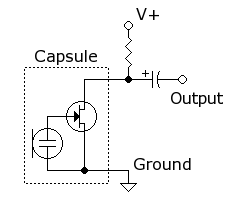
I noticed something odd about the way they wired up an electret microphone.  Rather than wiring it up as shown on the left… they instead mirror the positive side; feeding through a resistor to 0V, but tapping off via a series capacitor to the CODEC input (see right; click image to enlarge).  Why were they doing this I wondered?  Then I found it.  Inside the electret capsule is a J-FET which amplifies the weak signal from the microphone itself.  By hooking a resistor on both sides, and using two capacitors, they were creating a phase splitter.  I stumbled across that article on Wikipedia, and it was then I knew what they were doing.

So I’ve done the same thing here… Rather than a single-ended design, I have interfaced the electret microphone to the radio using the phase-splitter technique.  The schematic I use (with DB15HD pinouts) is below:

FT-897D Headset interface

I’m yet to take the whole shebang for a ride… I have a 6′ long CB (27MHz) whip that, last time I tried, tuned up nicely on 10m and 6m… might work somewhat down on 20m. I have had a VK2 station come roaring in at S7 when listening on 80m via this antenna on the back of my fold-up bicycle, but unsurprisingly it’s pretty deaf there… I plan to get a second antenna mount and suitable spring (so the antenna doesn’t get snapped by a low branch), make up a new bracket, and mount that some time in the coming weeks… then we shall see what the bands are like around Brisbane.

Status update

Hi all,

This is a short one, as it’s way past my bedtime as I write this. I’ve been quiet lately; non-existent on IRC and IM channels, and not a lot of activity.

I’ve been doing a lot of work out at Laidley earning an income, and thus Gentoo has taken a bit of a back seat. Particularly with stagebuilds, which I’ve been meaning to get back onto for a long time. Some of the things I’ve been chasing in the background include:

  • Chasing some odd Qt-related bugs that cause an in-house developed app to crash (one bug is a Bus error when calling QPointF::setX on a valid QPointF object, another crashes Qwt)
  • Some issues with KDE 4.3, particularly libkjs which appears broken
  • Mozilla products; and their severe instability
  • GNU Insight. 6.8 doesn’t work with present X, 6.8-1 lacks an ebuild, and doesn’t respect make install DESTDIR=/foo (Lord knows how binary packages are made of it?!)
  • GNU Toolchain and dev tools for Luminary Micro Stellaris LM3S8962 and friends… we use this controller at work, CodeSourcery’s toolchain was fun-and-games to compile on mipsel, as was figuring out openocd, but my Yeeloong is now my primary workstation for this development.
  • Chasing up packages needed to build newer stages

In the midst of this, a recent storm blew up some equipment in our house, namely a D-Link DSL-504 ADSL router (shall be missed; was a good router but now Ethernet on it is cooked), one 10/100Mbps ethernet switch (cheap 8-port Netgear), and worst of all… a Yaesu FT-897D transceiver (cooked 3 diodes in the power circuits, the microphone preamp and a DDS chip… a write-off). The latter I had hoped to hook up to some of the MIPS boxes, and get hamlib going. The SGI O2 has working sound on Linux these days, and would possibly make a decent PSK31 station.

Luckily, the Lemote Fulong that resides in my room, got spared from that storm. Both Fulongs are capable of running from 12V… and I suspect the ground-strike came up through the mains. Thus, I’ve already purchased a solar panel & regulator, and have two ex-Telstra 6V 110Ah batteries to power the radios with — they can also theoretically power the Fulongs and an Ethernet switch if I expand the panels up a bit in the future. So hopefully no further issues, not sure how many Gentoo dev boxes are solar-powered at present, but this is an option I’m considering.

I’m unlikely to be back on IRC, as I don’t have the time to check it these days with my long commutes. That said, there is email; and I will see emails sent directly to me… I don’t always get a chance to delve into the mail folders that hold list messages.

Cloning the Wouxun KG-UVD1P

Figured I’d share this trick. The KG-UVD1P dual-band handheld produced by Wouxun supports a feature whereby all settings and memory channels can be transferred to a second handheld using a wire clone cable.

Unfortunately, nowhere describes the wiring of the cloning cable… well… none that I have seen. The Wouxun handhelds use the same wiring standards as Kenwood radios, so same headset pinouts, same PC interface cable schematics. They use 3.3V TTL signalling — just a level shifter is needed for RS232 communications to a host computer.

For those who are interested, this is the pinout for the headset connector (taken from the Kenwood TH-F7E handbook):

“Ear” (2.5mm) “Mic” (3.5mm)
Tip Speaker 3.3V reference
Ring Remote Microphone
Sleeve 0V PTT

I’m not sure if the “Remote” is actually used on Wouxuns… on the Kenwood handheld, this is where the three programmable buttons connect, each one via a series resistor in parallel (PF1 is 3.9k, PF2 is 10k and PF3 is 27k) — there is also a lock switch which shorts this pin to 0V. The Microphone connection provides a bias for electret microphones, this may be blocked by a 10pF capacitor.

To hook the handheld up to a computer for programming, one needs a different cable. The connections into the handheld are via the same two connectors, but now the signals are different:

“Ear” (2.5mm) “Mic” (3.5mm)
Tip N/C N/C
Ring RXD N/C
Sleeve 0V TXD

A level shifter is needed before the port is RS-232 compatible. In this pinout though, lies the secret to cloning the KG-UVD1P. The cloning cable simply connects the RXD to the TXD on the other radio, and 0V to 0V. No level shifter is necessary since both sides of the cable use the same logic. I constructed a cloning cable using two 2.5mm and two 3.5mm stereo phono plugs, just hooking the 0V lines together, and ensuring RXD at one end, hooks to TXD at the other.

As for the actual procedure, the handbook I found, took a bit of re-reading. The procedure is thus:

  1. Turn BOTH radios OFF
  2. Plug in your cloning cable to both radios
  3. Power on the destination radio, it powers up as normal.
  4. Power on the source radio with the MONI button held in (this is the lower one on the left hand side). “COPING” is displayed.

During the process, the red transmit LED will blink on the source radio, while the destination’s green receive LED blinks. Eventually both radios will reset — you will see the first radio returns to where it was before it was powered off, the second radio will also display the same screen content, and have the same settings.