Redhatter (VK4MSL)

Gentoo/MIPS O32: New builds

Recently, a new version of binutils was released.

I had reported earlier about some patches needed to work around errata bugs in the Loongson CPUs.  There were also some other big updates since.  GCC 4.5 and Perl 5.12 have both been unmasked, enough has changed to warrant a rebuild before things get too far out of date.

This release will come with binutils-2.21 which incorporates many fixes for linker issues on MIPS, as well as the Loongson errata.  I have successfully compiled KDE 4.5 using a CVS HEAD version of binutils snapshotted around the time that the 2.21 branch was created, and found that it has fixed quite a few issues.

If you haven’t upgraded just yet, hold on a few weeks and I’ll have new stages up for all to try out.  MIPS-I Little-Endian is building now as I type this, I’m in the process of building seed stages for big-endian builds.  MIPS-III and MIPS-IV little endian builds will begin very soon too (before noon AEST).

I expect I should have most of the little-endian builds up before new year, and the whole release out in early January 2011.

VMWare Server 2.0: How web-based fails and a work-around for the masses

Well, I’ve recently gained some employment where I’m making use of VMWare Server to run a Windows 2003 virtual machine.  This VM runs ION Enterprise, Schneider Electric’s energy management package.  The project I’m working on will involve communicating with this software package.

Now, I’m working from home, and luckily I had the foresight to upgrade my desktop (actually, my hand was forced, the old one died) and I settled on purchasing a new 64-bit system based around the AMD Phenom II X6 1090T, which amongst other things, features the AMD-V virtualisation feature.  I’ve used it with VirtualBox OSE and it runs rather well.  However, for this job, the image I had was for VMWare.

Yes, I could “convert” it over to running on VirtualBox, but what if the hardware was different?  Windows doesn’t like that sort of thing.  The CPU changing model would be bad enough, and there was nothing I could do to prevent that, but I wanted to keep as much identical as possible.  So I began by installing VMWare.  There were two options I considered; Server and Player.  I figured Server had some nice features, one of which being that I can access the VM remotely.  I often like to work on the front verandah at home where there’s a nice cool breeze, this would enable me to run client software on my laptop and access it via the network.  Sounds good.

Sounded good.

The web interface firstly, relies on SSL 2.0 as its means of security.  Ewww! SSL3 was out in 1996, why are we using a security protocol that’s so old, and fundamentally broken?  Well, I’m not sure whether SSL3 is absent, or broken with regards to Firefox, but Firefox sure doesn’t like it, and won’t talk to the web interface until you apply one small hack to about:config, which enables SSL 2.0.

Now, once that’s done, you can at least log in and do things with the server.  All well and good.  I had some fun and games getting the image to boot, it turned out the disk image set for one of the drives was in the wrong place.  Some symbolic linking fixed that, and I had Windows 2003 booting.  No worries, but where’s the screen? I’ll come back to this.

VMWare Server 2.0 abandons the remote console it appears in favour of a web interface.  They don’t mention this in the documentation however, and when I at first couldn’t get at the web interface, my first instinct was to just install app-emulation/vmware-server-console. At first it refused to start, I had to apply some patches and install libraries from here to get it to even come up, lest I got a message about undefined symbols. It’s times like this I really begin to despise closed-source software. The clincher though was when I tried to log in, I was confronted by this:

Unable to connect to the remote host: 501 Global command GLOBAL server-vmdb to non-host agent targets not supported.

No one seems to know exactly what that geek-speak gibberish is supposed to mean. Best I can ascertain is that current versions of VMWare Server Console are for VMWare Server 1.0, and not compatible with its more modern counterpart. Everyone’s solution was to “use the web interface”. Now prior to that SSL hack, all I’d get is the server slamming the door in my face. Firefox would refuse to connect remotely. I discovered I could log in when running a local Firefox instance on the machine running VMWare Server.

That’s fine, got the VM set up and booting, try to bring up the screen. At first it needed to install a plug-in for the VMWare console, that’s fine, I do this and restart Firefox (3.6.8), then try again. I click on the screen area. It sits there for what seems like 30 seconds doing nothing, no acknowledgement that I had clicked it, I clicked a few times before it finally informed me:

Cannot access virtual machine console. The request timed out.
The attempt to acquire a valid session ticket for "Windows 2003 Server" took longer than expected. If this problem persists, contact your system administrator.

I did exactly what it said. I conversed with myself at considerable length to the problem while I researched the problem. I drew blanks every time. F$#!% VMWare, what ever happened to a desktop client?! Heck, why not open a VNC port or something?

Further research seemed to suggest it was a glitch with Firefox 3.6. On a hunch, I fired up VirtualBox, and started up a Windows XP VM which had IE8 installed. Pointed that at VMWare, and voila, I was in. It seems extremely silly to require another VM (a competing VM no less) to access the first, but at least I had access. That got me thinking as to whether I could coax the plugin to work somehow.

This morning, I had another crack at it. Looking in the Mozilla extensions, I noticed the following directory structure:
stuartl@beast ~/.mozilla/firefox/new7diw5.default/extensions/VMwareVMRC@vmware.com $ find . -maxdepth 2
.
./install.rdf
./plugins
./plugins/vmware-vmrc
./plugins/bin
./plugins/np-vmware-vmrc-2.5.0-122581.so
./plugins/vmware-vmrc-daemon
./plugins/xkeymap
./plugins/vmware-desktop-entry-creator
./plugins/lib
./plugins/open_source_licenses.txt
./plugins/share
./plugins/vmware-vmrc-legacy
./plugins/libconf
./install.js
./components
./components/xpcom-vmware-vmrc-2.5.0-122581.xpt

Ohh, a bin and lib directory? Interesting. I had a peek inside.

stuartl@beast ~/.mozilla/firefox/new7diw5.default/extensions/VMwareVMRC@vmware.com/plugins $ ls -l
total 904
drwxr-xr-x 2 stuartl stuartl 4096 Dec 15 17:17 bin/
drwxr-xr-x 61 stuartl stuartl 4096 Dec 16 07:25 lib/
drwxr-xr-x 4 stuartl stuartl 4096 Dec 15 17:17 libconf/
-rw-r--r-- 1 stuartl stuartl 684016 Oct 10 2008 np-vmware-vmrc-2.5.0-122581.so
-rw-r--r-- 1 stuartl stuartl 201997 Oct 10 2008 open_source_licenses.txt
drwxr-xr-x 4 stuartl stuartl 4096 Dec 15 17:17 share/
-rwxr-xr-x 1 stuartl stuartl 738 Oct 10 2008 vmware-desktop-entry-creator
-rwxr-xr-x 1 stuartl stuartl 738 Oct 10 2008 vmware-vmrc
-rwxr-xr-x 1 stuartl stuartl 738 Oct 10 2008 vmware-vmrc-daemon
-rwxr-xr-x 1 stuartl stuartl 738 Oct 10 2008 vmware-vmrc-legacy
drwxr-xr-x 2 stuartl stuartl 4096 Dec 15 17:17 xkeymap/

There were no executable bits set at the time however. They are AMD64 binaries however. So I chmodded and tried running vmware-vmrc. It failed due to some other permission errors, particularly lib/wrapper-gtk24.sh, needed execute bits set too. After fixing that, and some permissions on ~/.vmware which wound up being owned by root, I was looking at the VMWare Remote plugin … running stand-alone.

VMWare Remote Console plugin

VMWare Remote Console plugin, working stand-alone

This is about as close as I can get to a separate app. It took a bit of experimentation to get this to work, but in the Hostname field, you need to include the port number; so in my case it was localhost:8333. The rest is fairly self explanatory. I still can’t log in via the web interface, but at least now I can get in without a second VM.

Ohh, another rant, they forgot CTRL-ALT-DEL. Luckily, there’s this. Use the numeric keypad dot (also “del”), that seems to work here.

New toy

I picked up a few new toys recently.  I’ve been looking around for a small microcontroller based device to act as a combined remote face / DTMF generator for my FT897D.  The idea is that this device could interface with the FT897D via its CAT port, and allow me to adjust the frequency and mode, recalling the information from internal flash or an SD card.

The remote face would then be mounted on the front of the bicycle, and connect to the radio at the rear to allow easy bicycle mobile operation.  An extension of this would be control of a separate 2m radio, and a GPS to allow APRS from the bicycle.

The idea was to have the memory work like a relational database.  Rather than just recalling memory channels, and having a big long list, I could scroll through the repeaters by callsign, location (service area), or combined with GPS, proximity.  Modern flash technology would make this easily doable.

Likewise, for DTMF, rather than having to carry around a cheat sheet or remember IRLP node numbers, wouldn’t it be nice to just be able to scroll through a node list by country/region/callsign, select one, hit the “Call” button, put your callsign across and have it automatically dial the moment you raised the PTT?

I don’t have the ability to manufacture PCBs of the standard required for ICs such as most 32-bit microcontrollers.  SOIC is about as fine as I can muster, and prototyping services are expensive.  Thus I was looking for a stamp module or premade board.

Luminary Micro (now TI) make a few nice ones, and during my work at Laidley, I got to use the LM3S8962 Ethernet/CAN evaluation board.  One nice feature was that it had the JTAG built-in via a FTDI USB-serial chip.  However, the licensing for the board support package irks me — despite their code being useless on anything other than one of their chips, they still see it necessary to modify the BSD license adding a clause that prohibits its use on non-TI microcontrollers.  I had a crack at writing my own “free-software” Stellaris library, but haven’t gotten that far with it.

I happened to stumble on this board based around the STM32F103VET.  They were being sold on eBay for about $60 at the time, so I decided at that price I’d buy three.  ST’s driver library appears to be very liberal in its licensing (in fact they claim there is “no license”, I don’t know if this means “public domain”, or whether I treat it like BSD).

The LCD panel uses the Ilitek ILI9320 display controller with internal graphics RAM, and is capable of 18-bit colour.  The board also features a RTC backup battery, Texas Instruments TSC2046 touchscreen controller and on-board RS232 level converter.  The STM32 also functions as a USB peripheral, and can be programmed using the stm32loader bootloader script via RS232.

Interestingly, the LCD controller documentation states that no part of that documentation may be reproduced without written permission.  I’m not sure if writing an open-source driver classes as “reproducing” the documentation (as I’d be making documented #define statements in C).

The devices come with example source and have a pre-loaded µC-GUI demonstration on them.  So far I’ve managed to distill enough out of these sources to get working touchscreen, LCD and UART.  I’ll probably start looking at FreeRTOS next and seeing if I can get a workable device going.

STM32F103 board

STM32F103 board running a simple "Hello World" app

Hello world application for STM32

Hello world application for STM32

Guess now I had better start planning my application. 🙂

Gentoo/MIPS O32: New binutils == new builds

Well, binutils-2.21 has been released. Amongst the changes were some fixes for Loongson 2E and 2F systems, and a whole host of MIPS related commits.

I tried experimenting with one of the binutils CVS releases, and had good success building Qt and the KDE desktop on the Yeeloong. I still have issues with JavaScript in Konqueror, and some other apps are glitchy, but the desktop is usable on MIPS, and is reasonably responsive.

It is my plan to fire up the MIPS systems for a new round of stagebuilds for the O32 port of Gentoo/MIPS. These will hopefully include the latest binutils release, latest Perl and gcc.

Gentoo/MIPS Progress update and LCA news

32-bit Gentoo/MIPS stages for both big and little endian systems are now available for MIPS-I, MIPS-III and MIPS-IV.  For now I’ve got these on my devspace, but I hope to get some of them out to mirrors as soon as possible.  I’d appreciate any feedback on this release.

The little-endian stages should work on Loongson systems.  All stages include a patched binutils binary (see bug #338405) which adds some fixes for errata in the Loongson 2F CPUs and the little-endian stages for MIPS-I and MIPS-III have this fix enabled in the CFLAGS, enabling their use on Loongson hardware.  They will also work on non-Loongson systems.

I’ve been doing quite a bit of testing with the little-endian stages in particular, and have had few problems with getting many software packages to work.

binutils-2.21 already includes the fixes needed, along with lots of other MIPS-related fixes… and so when that is released (they’ve already done a branch freeze for 2.21) I plan to build new stages based on this newer toolchain, and with the newer Perl release.  Current stages use Perl 5.8.8 since I found I hit a few snags at the time which I thought were better dealt with later (some package complained there was “something funny about this Perl version” and bombed out) as the primary concern for the Gentoo/MIPS port at the time revolved around gcc.

I downloaded and installed binutils last night, based on that day’s CVS snapshot.  I’m now trying to see if I can get qt-webkit to build (the biggest sticking point so far) using that, with the view of having a workable KDE-based desktop going on the Yeeloong and the Fulongs here before LCA 2011.  (For now I’ve got FVWM.)  In the meantime I’ll be keeping an eye on the binutils mailing list.

On the LCA front… I got formal confirmation of my payment on the weekend… so I’m definitely a go-er… I’m still trying to find out if I’ll be helping out with any stalls…

There’s a social meeting of the Brisbane Amateur Radio Club this Friday, wherein our involvement in LCA will probably be discussed — club president was supportive of the idea when we discussed it on our 2m net last Wednesday evening… we just need to figure out what we can do, who can do it, and what needs to be done.

I’ve managed to get fldigi going on Gentoo/MIPS, and so maybe interfacing one of the computers I have (either one of the Fulongs or the O2) to a radio transceiver… (perhaps one of the ships’ radios on the HMAS Diamantina… nice mix of old+new-er) decoding some RTTY or PSK31, is an option.  We’ll have to decide this formally.

Those who wanted to drop in… we meet at the Queensland Maritime museum this Friday (and every second and fourth Friday except fourth in December and second in January) at 7:30PM — entrance is via “Service Gate 2” off Lower River Terrace.  We meet in the lunch room under the bridge.  If anything is decided, we will likely make our final decision at the following business meeting, which happens a fortnight later.

BARC Meeting entry point

BARC Meeting entry point... via Service Gate 2 off Lower River Terrace

If Gentoo has a stall, it’d definitely be worth setting up one of the Fulongs there… and for that I’d want a reasonable desktop going (KDE, or maybe XFCE… I know people have done some stunning work with FVWM, but I’m not that good).  I look forward to LCA regardless… if neither Gentoo nor BARC are running a stall in the open day, then I’ll just have a look around and see what it’s all about.  I look forward to the event anyway. 🙂

Battery management system musings

One thing I do enjoy is bicycle mobile operation… that is, operating the radio whilst traveling on the bicycle. One significant barrier to this is battery life however.

So far I’ve stuck with 13.8V 9Ah gel cell batteries. These are far from ideal, but are pretty good for the price. They are lighter and cheaper than an equivalent capacity NiMH or NiCd pack, however one downside is that they do not take too kindly to deep cycling.

When I first started my work at Jacques Electronics, I found one battery would get me there and home again, with capacity to spare. I’d have one at home charging, and the other on the bike.

This was with plenty of activity on the 2m band, transmitting full power on the FT-290R II. Given this radio has a 25W linear amplifier, this represents an approximate 4A load when I went to transmit.

Towards the end of my time there, I noticed the capacity had been significantly reduced. A combination of road vibration and deep cycling had reduced the capacity to the point that I now need to take two batteries with me.

So once again, I’m looking around. They seem to go for about 6 months before they start to fail… and we’ve already got a big collection of dead gel cell batteries ready for recycling… something has to change.

Lithium Iron Phosphate (LiFePO4) is what I’m looking at. Now, there’s a choice… do I go for pre-made packs? Or do I homebrew my own out of cells?

For the latter to be an option, I must consider how I’ll balance them properly. These cells are expensive and not very forgiving (although they’re better than Lithium-Cobalt or Lithium-Ion Polymer cells). What follows is some thoughts on how to construct such a battery management system… which could be completely wrong… so don’t take this as gospel.

The mission

To construct a battery pack to replace the 13.8V 9Ah gel cell packs, using Lithium Iron Phosphate technology. The battery may develop a maximum voltage potential of 15V DC, and must provide at least 9Ah effective storage capacity.

Cell count dimensioning

Looking around, the literature I can find suggests the typical LiFePO4 cells have an operating voltage between 3.2 and 3.6V. Therefore, to obtain 13.8V, I’d need four of them in series… producing 12.8V to 14.4V.

The cells themselves come in various capacities… some I can get easily are K2 Energy 26650EV cells. These pack about 3.2Ah per cell… EVWorks sell them for under AU$8 when you buy 10 or more. If I’m to use those, I’d need 3 cells in parallel to give me approximately 9.6Ah.

Total number of cells: 12, at $7.15 a cell: AU$85.80 for a 4S3P pack.

“Ideal” cell balancing

Now, the best way I can think of to balance these things, is to do it on the individual cell level. To maintain maximum life of an individual cell, one must ensure that when charging, the cell voltage does not exceed 4.2V. When discharging, the cell voltage must not fall below 3V.

There are also factors such as current flow, cell temperature and age. However, for simplicity’s sake, we’ll consider only the voltage for now.

Given these restrictions, it would seem wise to break apart these two actions, and consider them separately.

Charging

The desirable feature when charging an individual cell, is that the cell voltage itself is prevented from exceeding 4.2V. This is of great importance with some Lithium type batteries, as the cells can explode.

My first instinct is to look at zener avalanche breakdown in diodes. A zener diode in reverse bias will continue to reject current flowing through it until such time as the avalanche voltage is exceeded. Then it begins to conduct, and the voltage drop across it will always be equal to the avalanche voltage… given sufficient series resistance.

This sounds like the sort of behaviour we’re after. So the input circuit becomes something like this:

Therefore we look for a zener that has the avalanche voltage close to (but below) the 4.2V needed. Bad news is, there isn’t a 4.2V zener, we can go 3.9V… a little too low, or 4.3V, a little too high.

By adding an otherwise gratuitous 1N4004 diode between zener and battery, we can utilise a 5.1V 1N4733. Due to the forward voltage drop of the 1N4004, the battery will only see voltages up to 4.0V despite the higher zener voltage.  When the battery is below this voltage, it will charge with a current decided by Rlim.

This circuit certainly won’t fast-charge a big pack… but in my case, an overnight charge is quite acceptable. The individual Vcharge+ and Vcharge- are wired in series to charge all the cells from a higher voltage supply, and the strings themselves may be wired in parallel.

Discharging

All good and well, but what’s the point of stuffing a battery with charge if you’re not going to take the charge out at some point? The other side of the equation is discharging.

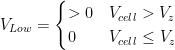
The magic number to beware of, is 3.0V… drop below that, and the cells will be irreversibly damaged. The same tool, the zener, can be used to detect when the battery is low. One trick we can do is to swap the zener with the resistor normally placed in series with it. The zener will still have its avalanche voltage across it, the resistor’s voltage now indicates the state of the battery.

V_{Low} =  \begin{cases}  >0 & V_{cell} > V_z \\  0 & V_{cell} \le V_z  \end{cases}

If we pass this through a NPN transistor, we wind up with negated output that can directly drive two MOSFETs. One MOSFET will permit the current to flow only when the cell voltage is above the zener avalanche voltage. The other, will shunt current past the cell when the voltage of the cell is too low.

All good… but the MOSFETs would want to be capable of delivering about 20A continuous for my needs. An IRF9540N could do it with a heatsink. That’s not so much a problem, but the cost is. Each MOSFET costs about $5 locally… so there’s $10 per cell, 12 cells… $120 just in MOSFETs… the BMS will cost more than the cells!

Reducing costs

The charging side is fine, however the discharging aspect of this system is going to be too pricey for my liking. So a re-think is needed.

The same current that would turn the NPN on, could instead turn on the LED in an optical isolator. An optical isolator incorporating a NPN transistor would then pull down on a resistor when the cell voltage is above the zener avalanche voltage.

In this circuit, when the battery voltage is high enough, the optical isolator is active, pulling the NPN’s base low and leaving VnLow floating.  All modules’ VnLow signals would be wired together, forming a wired OR with the open collectors.  When a cell gets below voltage, the LED turns off, causing the isolator to turn off and the NPN’s base to rise.  It then turns on, and pulls VnLow down.

This signal with a suitable pull-up resistor can drive a NPN transistor for driving a P-channel MOSFET, so that when VnLow gets pulled low, the load is disconnected and an alarm raised.

This BMS, while undoubtedly not as good as the previous option, would provide the low-voltage protection, and can be made for under $50. I’m curious to know how others’ have tackled the problem though. This is how I’m thinking of approaching it… I may just buy a premade pack instead.

You know you’re a ham when…

I stumbled upon this looking up information on magnetic receiving loops.  Content is below, with my comments added.

1. When you look at a full moon and wonder how much antenna gain you would need.

2. When a friend gets a ride from you and remarks that you have a lot of CBs in your vehicle, it turns in to an hour long rant on how ham radio is not CB radio.  (Not quite… but I have had people ask if that’s a “CB” on my bike, and I’ve responded no, it’s an amateur set.)

3. When someone asks for directions, you pause, wondering if long or short path would be best.

4. When you can look at a globe and be able to point to your antipode (and you know what an antipode is).

5. Your cell phone ring tone is a Morse code message of some kind. (Yep… my phone taps out “VK4MSL”)

6. You have accidentally said your Amateur Radio call sign at the end of a telephone conversation. (Almost did this once leaving a phone message back when I had a F-call… almost blurted out “VK4FSJL clearing the frequency”)

7. Your favourite vacation spots are always on mountain tops.

8. You notice more antennas than road signs while driving your car. (I do notice antennas a lot more these days when I’m riding the bike)

9. You have driven onto the shoulder of the road while looking at an antenna.

10. Porcupines appear to be fascinated with your car. (We don’t get porcupines in Australia and echidnas are rare in suburbia.)

11. If you ever tried to figure out the operating frequency of your microwave oven.

12. When you look around your bedroom of wall to wall ham gear and ask: Why am I still single? (This bloke can see his bedroom wall?!)

13. The local city council doesn’t like you.

14. You actually think towers look pretty.

15. Your family doesn’t have a clue what to get you for Christmas, even after you tell them.

16. Your HF amplifier puts out more power than the local AM radio station.

17. The wife and kids are away and the first thing that goes through your head is that no one will bother you while you call “CQ – DX” a few hundred times.

18. When you pull into a donut shop and the cops there on their coffee break ask if they can see your radio setup.

19. You refer to your children as your “Harmonics”.

20. Your girlfriend or wife asks: “You’re going to spend $XXXX on what???

21. You plan family vacations around hamfest dates.

22. When you see a house with a metal roof, and your only thought is what a great ground plane that would be.

23. You have pictures of your radio equipment as wallpaper on your computer’s desktop.

24. Every family vacation includes a stop at a Ham radio store.

25. The first question you ask the new car dealer is: “What is the alternator’s current output”?

26. You buy a brand new car based on the radio mounting locations and antenna mounting possibilities.

27. You have tapped out Morse code on your car’s horn. (I may try this if I ever mount a horn on the bike)

28. A lightning storm takes out a new Laptop, Plasma TV, and DVD Recorder, but all you care about is if your radios are okay. (Good riddance to the Plasma… they should be banned… I too have more concern for my radios…)

29. Your wife has had to ride in the back seat because you had radio equipment in the front seat.

30. Your wife threatens you with divorce when you tell her that you are going on a “fox” hunt.

31. Your wife says ‘the kids need to be fed’ and you first wonder what their impedances are.

32. When house hunting, you look for the best room for a radio shack and scan the property for possible tower placement.

33. When house hunting, you give your realtor topographical maps showing local elevations.

34. The real estate agent scratches his head when you ask if the soil conductivity is high, medium, or low.

35. You have Ham radio magazines in the bathroom.

36. When your doorbell rings, you immediately shut down the amplifier.

37. Fermentation never enters your mind when “home-brew” is mentioned.

38. Instead of just saying no, you have said “negative”.

39. You have used a person’s name to indicate acknowledgement.

40. You become impatient waiting for the latest AES catalog to arrive.

41. You have found yourself whistling “CQ” using Morse code.

42. You always schedule the last full weekend in June for vacation.

43. You walk carefully in your back yard to avoid being close-lined. (Make that step carefully around back deck to avoid tripping over feedlines)

44. You have deep anxiety or panic attacks during high winds or heavy ice.

45. You and the FedEx/UPS men are on a first name basis.

46. You really start to miss people that you’ve never seen.

47. Your exercise machine is a Morse code keyer.

48. You walk through the plumbing section at the hardware store and see antenna parts.

49. Your neighbours thought you were nuts when you ripped up your lawn to bury chicken wire.

50. Your next door neighbour thinks that your wife is a widow.

51. Your wife has delivered meals to your Ham shack.

52. If you sold all your Ham radio equipment, you could pay off your mortgage.

53. Removing snow from the roof of your car requires working around the antenna and wires.

54. You have never seen a Meteor Shower because you are inside on 6 meters when they occur.

55. If your radio equipment has a more advanced processor than your PC.

56. You hear about a pileup on the local news and you run to your radio equipment and start calling CQ.

57. If you install ferrite beads and place shrink tubing on your toaster appliance cords.

58. If your wife puts something on and asks “Does this make me look too fat?” and you reply with: “Honey you have an excellent front to back ratio with appreciable forward gain on the front lobes.”

59. If you think the half human / half machine individuals on a Borg Cube are really just a friendly group of electronic experimenters with similar interests.

60. You have no idea as to the weather forecast for tomorrow, but know the solar forecast for the next month.

61. If your blood type is RF positive.

62. You sell your dog to buy an amplifier.

63. Your XYL says communication is important in a marriage…so you buy another radio for the shack.

64. You doodle Hartley and Colpitts oscillators during boring meetings.

65. ..your boss asks if you understand? And you reply “QSL” !!!

66. You have been going to the library since you were three and the only shelf you ever go to has Dewey Decimal number 621.

67. You have invested more on your radio equipment than on your kids education.

68. You hire a babysitter to come over, and then you never leave the house-you just go to the shack so you can contest undisturbed.

69. You occasionally buy a Playboy magazine and let your Mum find it , just so she can think that you are ‘normal’.

70. You’ll spend hundreds of dollars on a new rig, and then wander the hamfest pausing each time you pass the booth selling those $7 embroidered call-sign hats thinking “I wonder if they’ll take $6?”

71. When shopping for a new vehicle the first think you look for is space to mount the radios – you end up sitting in the front seat staring blankly at the dashboard area, feeling underneath seats, and poking around the back seat for ways to route the coax. If caught looking under the hood for holes in the firewall for your power cables, you tell your wife, “Nothing honey, just checking things under here.”

72. Your family has a special annual garage sale just to get rid of the boxes of wire, coax, and power adapters-but you pay your friends to “buy” the stuff and get them to quietly return it to you the following weekend.

73. The $10 bargain you got at the flea market that smoked up the whole house when you turned it on is one of your prized possessions.

74. Your wife has called you three times for dinner – then she calls you on the repeater.

75. When going on vacation, the first thing you think about packing is your hand-helds, chargers, scanner and frequency book.

76. The total number of radio related books in your home are five times the total number of all other books and magazines.

77. You visually check your outdoor antennas and coax once a week, regardless of the weather.

78. You have more certificates and licenses on the wall than your local veterinarian or dentist.

79. All the local cops know your vehicle on sight – “it’s the blue Ford with six antennas”. (“It’s that bike with the 6′ whip”)

80. You think an upside to gaining weight is more belt space for radios.

81. You immediately think of `tower’ when someone says the word – `erection’.

Some additions I’d add to the above list

82. When naming kids, you immediately think: Charlie, Juliet, Mike, Oscar, Romeo and Victor.

83. You prefer the grandkids call you Papa.

84. You plan your week around regular nets. (“C’mon, they’ll be expecting me on 3.590MHz in 15 minutes”)

Looking for work

The title says it all.  I’m currently in the marketplace looking for employment in the Brisbane area.  I’ve gained quite a bit of experience in the embedded systems area programming various microcontrollers (mostly ARM-based).  I also have a lot of experience with writing software for larger systems too.

If you are looking for someone keen to assist in your project, who is willing to try out new skills and genuinely enjoys a challenge… feel free to drop me a line.  You can find a copy of my CV here.

LCA2011: I’m going… are you?

Hi all,

I’m in the process of registering for LCA2011… since it’s in my home town, I figure I may as well show up. 🙂 This will be the first LCA that I’ve attended, last one I was looking at going to was the one in Sydney a few years back … however at the time I just didn’t have the funds.

Now, with it in Brisbane (therefore no need for a hotel room), and having some money in the bank, there’s no excuse for me.

I’m not certain if Gentoo is organising a stall there or not this year, and there’s mention of the Brisbane Amateur Radio Club (of which I am a member), not sure what activities are going there either (this could be in error… I’ll inquire with the group and see what’s doing). If we have a stall… figured it’d be a good opportunity to get one of the Fuloong computers up and running as a bit of a demonstration of Gentoo/MIPS… maybe get my O2 running fldigi with my FT-897D decoding some PSK31 as well if BARC are involved. We shall see.

What is certain though, is that I’m taking the plunge this year… before the earlybird pricing expires in early November.

CQ JOTA 2010

Hi all,

This year I will be activating the Robertson Scout Den as part of this year’s JOTA. I’ll be working as a one-man band at least on the Saturday, working under my personal callsign of VK4MSL. Bands planned are:

  • 80m
  • 40m
  • 20m
  • 2m

I can also do 15m, 10m, 6m and 70cm and may have a listen there too… however the above listed bands are where I suspect most of the action will be. Modes will be FM and SSB. On 2m, we can be reached on the VK4RBR-L Echolink node (#284321). JOTA documentation lists as also contactable via VK4RBS, which at last check was on IRLP node 6408. However, it appears this node has been down for some time, and as such we will likely also be making use of other 2m (and possibly 70cm) nodes in the region. I can also do 2m SSB, however that was very quiet last year.

Hope to hear many young voices on the air this weekend… let’s see if we can push the average operator’s age well below 20. 🙂 And next time I’m in contact with ZL2JOTA, I’ll try to keep the topic away from asking about sheep (ahh well, gotta forgive inquisitive minds… you could hear the groans baseband).