Homebrew

VK4MSL/BM HF: Second stationary test contact

Well… after borrowing an antenna analyser and tweaking a few things… I made my second stationary contact using the bicycle mobile station on 20m.  This time, using 20W transmit power.  I now know where to place at least one of the taps on this autotransformer for 20m use. 😉  The station borrows heavily on the “Wonder Whip” style concept, where an autotransformer provides a means of matching the wild variances in impedance of the antenna, to something reasonable for the radio to cope with.

Shown here, is the station, exactly as it was during this contact.  The fibreglass 6′ CB whip has been spray painted yellow to make it more obvious, I plan to put a flag on there so that it resembles a bicycle safety flag (a big one) so it arouses less suspicion.  Click on any of the photos for a closer view.

VK4MSL/BM HF: as set up during the contact

VK4MSL/BM HF: as set up during the contact

This weekend was the day of the Remembrance Day contest, which is one of the major contests ran by the WIA.  Tuning around on 20m, I heard Kirby VK7KC booming in a S8 from the apple isle.  At first I tried contact with 5W, no dice… then 10W, then 20W… no luck.

I tuned off, and tried a different tap on the autotransformer… bingo, that sounded a bit noisier… I hit the button on the autotuner to clean up any last issues with the SWR, then tuned back and had another go.  Eventually after some perseverance, contact was made.

Below is a shot of the FT897D showing the frequency and S-meter reading shortly after the contact was made…. I was weak into Tassie, but that didn’t matter to me… as far as I was concerned, if I got outside metropolitan Brisbane, I was happy.

FT-897D frequency and S-meter during contact with VK7KC

FT-897D frequency and S-meter during contact with VK7KC

I haven’t yet tried other bands, although I’ve figured out some tap points for 6m, 10m and 15m… and some possible maybe points for 40m although I think the antenna will be very deaf down there.

On 80m it’ll probably be a mostly receive-only antenna, with maybe a Tx range of under 10km… if it’s enough for me to know what’s going on with the AWNOI net before I get home … and to maybe get a message relayed to VK4SD so I don’t get hassled about a late note, it’ll be great. 😉

The transformer still uses a map pin pushed though to select the tap… I’m not sure how well this will go long-term, and I think moving towards using banana plugs (or at the very least, alligator clips) will be a better solution.  Switches are another possibility.  Something that will be a more reliable connection than a pin pushed through a wire.  Shown here, is a close-up of the rear basket, the autotransformer is shown underneath the antenna bracket… which helps provide a bit of capacitance.  I find having it close up against the bracket helps, although I made provisions to be able to hang it vertically too (thereby reducing the coupling).

Rear basket showing homebrew autotransformer

Rear basket showing homebrew autotransformer

For now I’ll probably solder the centre conductor of the coax in place of the map pin, so that it’ll stay put until I can find a more convenient solution.  At least I have something on HF that works to a moderate degree.  I’ll probably give it a try next weekend on my way to the Queensland Maritime Museum, where I’ll be operating the Bulwer Island lighthouse as VK4MM in the International Lighthouse Lightship Weekend.  Hopefully I can stir up 20m sufficiently so that there’ll be some activity when 00:00 UTC rolls around.

VK4MSL/BM HF: The autotransformer

Well, I did some experiments this weekend regarding the bicycle mobile station using an autotransformer to match the shortened end-fed whip (6′ 27MHz helically-wound) to the 50ohm impedance my set demands.

I haven’t tried this on the bike itself… these were done in my bedro^W(ahhem) “radio shack”… with the antenna and its bracket sitting on a wooden chair connected to a longer bit of coax than I’ll probably use on the bike.  I will have to try this on the bicycle (ideally with an antenna analyser) to get a better idea of performance, and the up-coming Remembrance Day contest may provide a good opportunity to gauge performance, as the bands will be sufficiently “busy”.

The autotransformer is a simple design… about 50 turns of cheap speaker wire (~1.5mm diameter; ~0.2mm insulation thickness) on a 42mm OD PVC pipe section about 160mm long.  The pipe has small holes down its length, drilled at a spacing approximately identical to the wire centre-to-centre spacing (2mm).  The two extremes of the coil connect to the antenna and the metal antenna bracket respectively, the latter also connecting to the braid on the coax going back to the radio (about 30cm RG58C/U coax).  The centre conductor of the coax connects to a short piece of wire which is soldered to a small map pin, which is simply pushed through the wire’s insulation, piercing it and poking through the hole in the PVC pipe… I can select any turns ratio from 1:1 to 1:50, achieving a very wide matching ratio.  (On paper, able to match >10kOhm impedances to 50ohm.)

Early testing seems to indicate the ability to obtain good SWR figures on 6m, 10m, 20m and 40m.  80m (the holy grail for me) eludes me… and I suspect the actual radiated signal will be very low down to most stations… but if I can cover parts of metropolitan Brisbane with it, I guess I’m doing okay.  The fact that this antenna got down to VK5 with 100W up it, is a promising sign… perhaps with the autotransformer, it may do better.  Then again, it may do a lot worse… We’ll see.  Plan is to try and get it up and running before the ILLW… so that I can stir up some activity on the bands on my way to the Bulwer Island lighthouse (AU0003) before becoming VK4MM and operating a station there.

VK4MSL/BM: Photos of the current setup

Well, I’ve been riding a lot between West End and The Gap, and I get a lot of questions from people on the band about my setup. I was doing some repairs… one of the wires to the PTT had disconnected, luckily there was a 0V return via other connections… and so while I had the bike outside fixing that (it was too dark in the garage) I took the opportunity to snap some photos.

The light was fading at the time, so the pictures aren’t particularly great… I’ve touched them up to make them brighter, hence there’s a bit of noise in the photo… The last two showing the HF setup, required a flash (which I was trying to avoid due to the aluminum and reflectors)… and of course I didn’t spend time putting the FT-897D in the back… maybe later when I get everything tuned up and actually do make a true bicycle-mobile contact on HF (this one was not made mobile).

VK4MSL/BM on 2m

VK4MSL/BM on 2m: side view

Above, is the station in its entirety… fairly simple. The antenna is a plain 2m ground-plane, formed using a tunable mobile whip cut for 145.700MHz, the aluminum angle bracket makes up one counterpoise, and an additional counterpoise hangs out the back. Adjusting the angle has an influence on the SWR… in this arrangement, it works nicely.

VK4MSL/BM: Closeup of rear basket

VK4MSL/BM: Closeup of rear basket

Shown here is the rear basket where the FT-290R II (or FT-897D for HF) lurks… along with a 9Ah gel cell battery, which also powers the tail light. I haven’t been very neat about the cables. Two leads run from the front controls, the grey one (shielded) carries transmit/receive audio and the PTT, the blue one (Cat5e UTP) carries the four directional buttons — with spare wires connected to 0V. A DB15HD (“VGA”) connector terminates the cable at each end.

VK4MSL/BM: Radio controls

VK4MSL/BM: Radio controls

Remember how I mentioned the hand-mic in the last station was going to be temporary? Well… this is the arrangement here. Shown here is the PTT switch (red) and four directional buttons. Not all radios make use of all buttons … the FT-290R II uses only the up/down buttons, the FT-897D uses the right-hand button in addition for the “fast” button. Homebrew microcontroller-based radios I build will probably use all five shown for a menu interface. There’s no display in front of me, so don’t ask for an accurate signal report, I can tell you whether it’s a Q3 or a Q5, but any S-meter reading will be a wild guess. Future expansion of this may include a small potentiometer for a local volume control, and a small microcontroller-driven LCD that could be used to interface to the FT-897D’s CAT interface… but this is just early days.

Now… I did say I managed to mount a HF antenna on here and make a contact with it. The contact into VK5 that yielded this QSL card was made using a 6′ long CB whip… the station looked a lot like this:

VK4MSL/BM: HF Antenna

VK4MSL/BM: HF Antenna

The flash was needed here, took me a while to figure out where I had put the bracket (I don’t plan to ride with the HF antenna or bracket mounted very often). This is fortuitous in a way since you can now more visibly see the 2m antenna. The CB antenna mounts on a nearly identical bracket. I don’t bother with the radial out the back, as there’s no way I’ll make one long enough that would be practical. The antenna will need some work, in particular, either addition of a base-load coil, or modification, to make it resonant on the amateur bands.

VK4MSL/BM: Closeup of basket with HF mount

VK4MSL/BM: Closeup of basket with HF mount

With a small base-load coil, I should be able to make it a half-wave end-fed on 6m… some more and I should be able to make an end-fed quarter-wave on 10m. This will be the subject of future experiments. This tuning section will probably mount on top of the mounting itself, underneath the spring shown on the right.

And to answer the number one question I get from non-radio amateurs… no… I do not have a camera on my helmet (this is not a camera)… I am not broadcasting video. Kindly don’ t act like someone excited to be on television… you’re not. 😉

VK4MSL/BM Part 2: Upgrade of bike… upgrade of set… HF here I come

Well… just this afternoon, I made some steps towards getting HF going on the bicycle mobile station.

I’ve had the station going a while now… and with the new workplace being so close to home, I’m often heard on 2m, usually on three repeaters:

  • Bayside VK4RBS: 146.875MHz FM
  • Mt. Cotton VK4RAX: 147.075MHz FM
  • Mt. Glorious VK4RBN 147.000MHz FM

Usually, it’s VK4RBS in the centre of town unless there’s activity on VK4RAX.  VK4RAX as I get closer to home.  I’d listen to the latter all the way, but pagers clobber the receiver on the poor FT-290R II.  Hearing pagers is bad enough … try it through a headset!  Made worse by the fact that the headset is a semi-homebrew design, embedded inside a motorcycle helmet… so I can’t easily take it off.  Once I’m out of the city however, the pagers aren’t an issue.

Range is pretty good… I use a quarter-wave ground-plane antenna on 2m… actually, the antenna itself is the same as on my previous bicycle-mobile station… a tunable whip antenna.  The antenna is intended for mobile use on a car, so to give it a reasonable counterpoise, I cut a 500mm long piece of aluminium angle, and bolted the antenna mount to that.  I found that alone, wasn’t good enough, and since added a 500mm long piece of copper wire that hangs out the back.  That brings the SWR down nicely into the range where the FT-290R II is happy to work with it.

I have been able to open the squelch of the Toowoomba (VK4RDD) repeater, once waiting at lights at West Ashgrove, and another time, underneath the Goodwill Bridge at the Queensland Maritime Museum near South Bank in Brisbane.  I also can work the Ipswich repeater, VK4RAI while walking up the hill along Cooper’s Camp Road at Bardon… about a distance of 80km out to the repeater’s location (near Marburg).

This is using the FT-290RII with the 25W linear option, and the aforementioned antenna.

This afternoon, I figured out how to interface the electret microphone in the headset to the FT-897D.  The wiring standard I use for my headsets is a customised one… using DB15HD connectors (VGA-like).  A female DB15HD exists on the headset side, this is to prevent some goose trying to plug a headset into a VGA card on a computer.  The following is a rough schematic of a typical headset using this wiring scheme.

Typical headset wiring schematic... looking into female DB15HD connector.

There are three pins that are normally unused… On a couple of my interfaces, +5V and 0V are wired up… it was initally thought I’d use these for power rails … one supplied by the headset (one of my planned “headsets” was a former in-car hands-free kit for a Nokia 3310, and so you’d be able to charge the phone this way), the other supplied by the device (many radios supply a 3.3V or 5V rail).

For the FT-897D, the microphone used is normally the dynamic type… that is, uses a balanced (differential) audio feed.  On the FT-290R II, I tie Mic – to 0V, and just use it single-ended, which works fine… but a better way is to actually convert the single-ended microphone signal to differential.  How does one do this?  Well, the answer came out of the TI TLV320AIC3204 datasheet which I’ve been reading quite a bit lately.

TLV320AIC3204 Typical Circuit Configuration, showing microphone wiring (Source & Copyright: Texas Instruments)

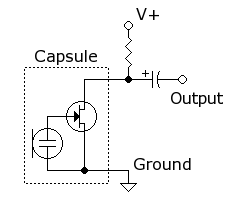
Typical electret microphone configuration (Source: Wikipedia)

I noticed something odd about the way they wired up an electret microphone.  Rather than wiring it up as shown on the left… they instead mirror the positive side; feeding through a resistor to 0V, but tapping off via a series capacitor to the CODEC input (see right; click image to enlarge).  Why were they doing this I wondered?  Then I found it.  Inside the electret capsule is a J-FET which amplifies the weak signal from the microphone itself.  By hooking a resistor on both sides, and using two capacitors, they were creating a phase splitter.  I stumbled across that article on Wikipedia, and it was then I knew what they were doing.

So I’ve done the same thing here… Rather than a single-ended design, I have interfaced the electret microphone to the radio using the phase-splitter technique.  The schematic I use (with DB15HD pinouts) is below:

FT-897D Headset interface

I’m yet to take the whole shebang for a ride… I have a 6′ long CB (27MHz) whip that, last time I tried, tuned up nicely on 10m and 6m… might work somewhat down on 20m. I have had a VK2 station come roaring in at S7 when listening on 80m via this antenna on the back of my fold-up bicycle, but unsurprisingly it’s pretty deaf there… I plan to get a second antenna mount and suitable spring (so the antenna doesn’t get snapped by a low branch), make up a new bracket, and mount that some time in the coming weeks… then we shall see what the bands are like around Brisbane.

VK4MSL/BM under construction part 1

Lately I have been riding my bike … a lot.  As in all the way into the Brisbane CBD and back again to my home at The Gap.  Lately, my handheld, a trusty TH-F7E has also given up the ghost… previously this is what I used when bicycle mobile — had that thing on the handlebars, and a small mobile whip on the back (which I never bothered to tune).

The handheld worked well… even better when I had the headset interface working.  However, SWR was high, and although my handheld never complained, my other radios did!  With the handheld gone, I had to finally deal with this issue.  The helmet that I previusly used too had also been replaced — with a new headset to go with it.  Anyway… that’s a side issue.

The big problem I faced was how to get this antenna tuned.  The antenna is a tunable whip, basically just a length of stainless steel with a suitable mounting at the base — you cut it to the length you need to achieve resonance.  Pretty simple.  c=fL, and since hopefully most of the energy is going to be on the surface of the metal, and the metal is not insulated, it’d be approximately 1/4 of the wavelength (L).  But what wavelength??

The radio I’m replacing the handheld with, is an old one… a Yaesu FT-290R II, which is an all-mode 2m radio.  Since I have an all-mode radio, it makes sense to set up the antenna for all the modes I am likely to use.  I don’t know CW very well, flat out decoding it when sitting comfortably at my desk, let alone whilst peddling up hills, so I’ll leave that to people like LY2KW.  SSB and FM however, are definitely on the money.  This is where the band plans come into play.

Here in Australia… the SSB portion is down the low end between 144.100MHz and 144.320MHz.  Then there’s an all mode allocation between 145.225 and 145.775MHz.  Everything above 146.025MHz is FM.  The highest I normally transmit on 2m is 147.500MHz, as there are repeater outputs above this.  Since I don’t know CW, the lowest I’m likely to go is 144.100MHz.  So in order to balance this, I split the difference and used that to choose my resonant frequency… which yields a frequency of 145.800MHz,  which puts me just at the start of the satellite segment.  Hopefully SWR won’t be too bad everywhere else.

So, back to the formula, c=fL.  Plugging the info in, I got a wavelength of about 2.057 metres.  So 1/4 of this … 514mm.  Out with the hacksaw.

Plugging in the radio, I found my SWR was still appauling… well… I don’t know my actual SWR, but the radio was telling me it wasn’t happy with it!  The power amp on the FT-290R II (I have the FL-2025 25W linear attached) throttles back when it sees a poor match — and this is shown on the S meter.  Okay… maybe I mismeasured… well it turned out that I hadn’t taken into account the fact that there’s about 30mm of metal at the base of the antenna holding it in place… so off that 30mm came.

Tried again… still no good… doing an estimated 12W, which while respectable, it’s probably no good for my finals.  Something else was the matter.

I did some probing around… yes, the shield of the coax was making good contact with the bicycle frame, but why was the SWR so high?  I was hoping that the frame would make for a counterpoise radial.  I knew it wouldn’t be a groundplane, but surely the frame being 1.5m long would count for something.  As a hunch, I tried adding some lengths of copper wire to the antenna mount, connecting to the shield.  Three of them extend 60 degrees apart, with one pointed straight out over the rear tyre.  That brought the SWR down.  So it seems although good contact was made, the aluminium frame made a bad counterpoise in other ways.  The following is the new arrangement.

Closeup of radials and antenna mountingWhip on luggage rackCounterpoise radials

Now, with that solved… I turned my attention to the radio mounting.  I don’t have any mounting brackets, nor am I likely to get any, so that method was out.  I had invisaged mounting it on the handlebars… well… I’ve sorta achieved that.  This will need fine tuning.

The FT-290 is intended as a portable rig, thus there is provisions there for a carry strap.  I’ll have to get a more suitable one, but I managed to find one that fits, and at least straps the top to the handlebars.  This does mean the back of the radio swings… I’ll have to sort that out before long, otherwise one old radio is going to get battered and bruised.  The strap loops over the top of the handlebars and around the steering post.  It looks okay for now, but I know I’ll need to tweak this.

Radio mounted on handlebarsFront handlebarsRadio ready for action

The setup is almost complete… I still have to work on the mounting.  It needs to be quick-release too so that I can take the radio with me when I chain the bike up.  Another option may be just to sling it over my sholder.  The battery sits nicely on the back luggage rack — a 9AH SLA battery, plenty of life for this radio.

The last piece of the puzzle is one of operation.  You notice the handmic slung over the handlebars.  This is very temporary, as I hate taking my hands off the handlebars when riding.  I replaced my helmet with another open face motorcycle helmet, similar to those worn by Australia Post delivery people.  Yes,  overkill on a bicycle, but the visor already has prooven useful in keeping rain or low branches out of one’s face (yet to see a bicycle helmet with one) and  the peak keeps the sun off well (again, most bicycle helmets are lousy at this).  It also makes it very easy to embed a headset.

The headset in this one is made up from two $10 computer headsets that broke.  The microphone is off one, the speakers out of another.  The audio quality is quite good, and shown in the photo below is what it looks like, with the adaptor for my mobile phone (Nokia 3310) attached.  The next step is to make another adaptor for the FT-290, and suitable PTT arrangement.  I’m thinking a toggle switch, since then I can flick it between transmit and receive without needing to hold a button down.  VOX doesn’t appeal. 😉

Helmet with headset embeddedBike almost ready to go

The bike isn’t quite ready yet, but hopefully I’ll get something up and running this coming weekend.  Then I shall be mobile once more.  I shall report back once I have given this a try out proper.